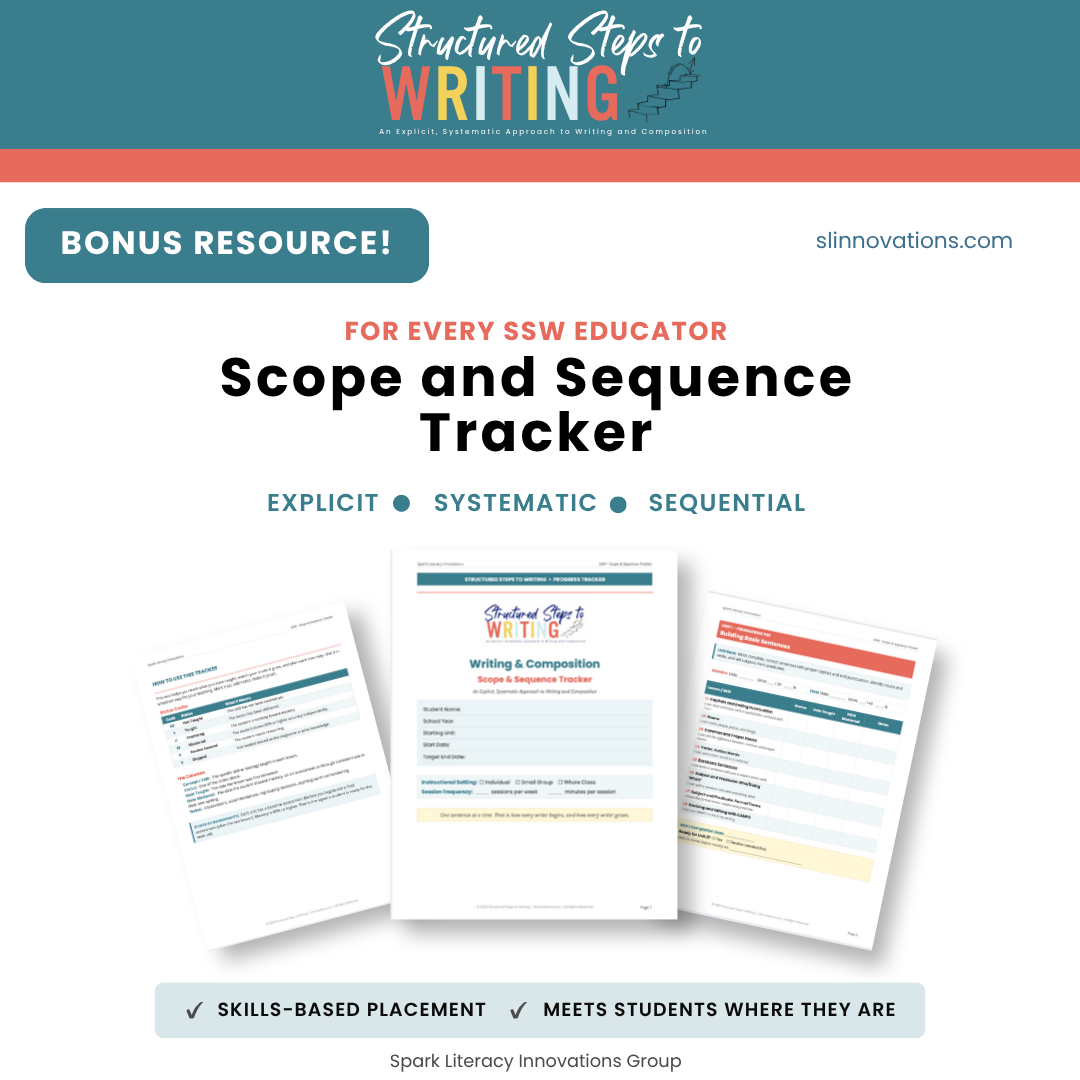
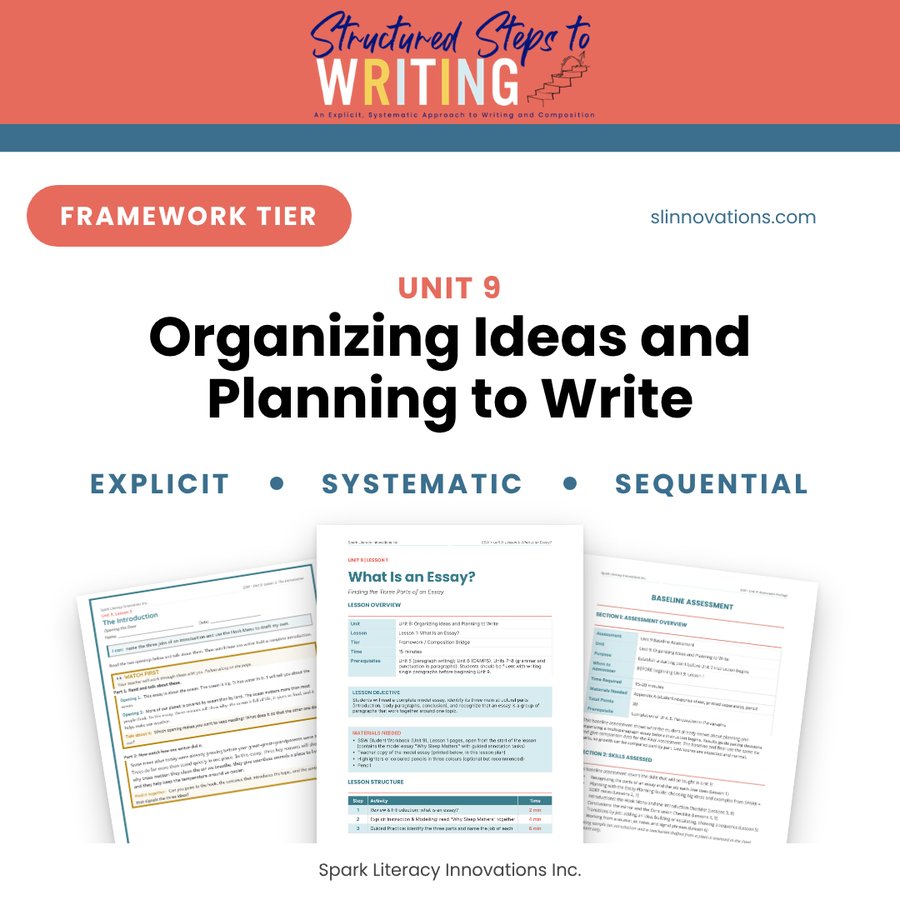
Framework is where sentences become paragraphs, and paragraphs become a planned essay. Unit 5 builds the paragraph. Unit 6 makes it better. Units 7 and 8 sharpen grammar and punctuation, and Unit 9 plans the essay. 15 minutes a lesson, fully scripted, no prep.
Most students take them in order. Each unit is $49 CAD, or all 5 for $219 with the bundle above.
A student finishes Foundations. They can write a complete sentence, expand it, vary it, and combine ideas. Then the task becomes "write a paragraph about sea otters," and the whole thing stalls.
Sentence skills don't turn into paragraph skills on their own. A student can produce five correct sentences and still have no idea how those sentences are meant to relate to each other, or what the next one is supposed to do.
So Unit 5 teaches that step the same way Foundations taught sentences. One skill at a time, explicitly, before the next one is introduced.
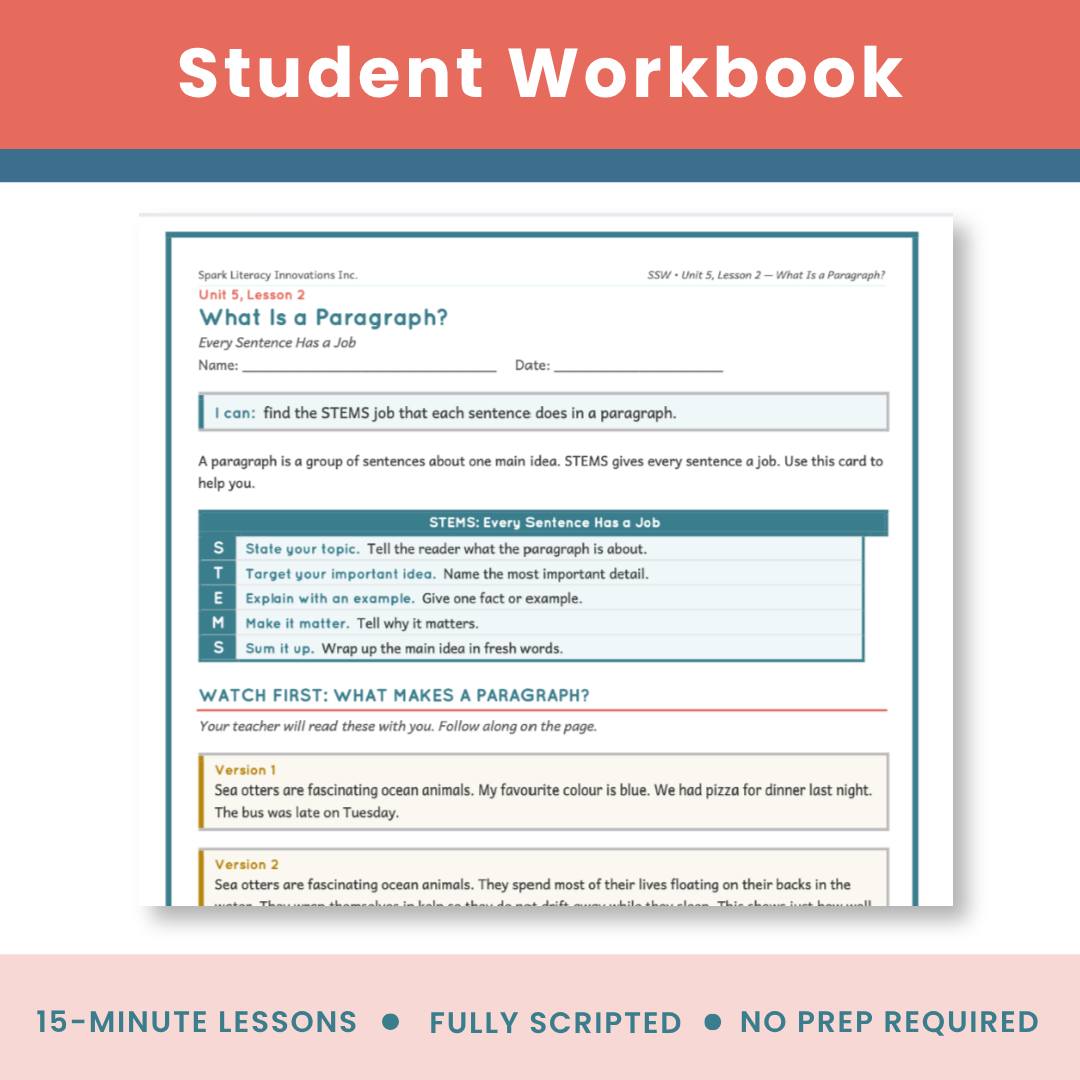
STEMS gives students a job for each sentence in a paragraph, so they always know what the next sentence is supposed to do.
Lesson 1 opens with SPARK+SORT for paragraphs, so students gather and sort their ideas before they write a word.
Open it and teach. Everything is written for you. Each unit builds directly on the last.
All prices are in Canadian dollars (CAD).
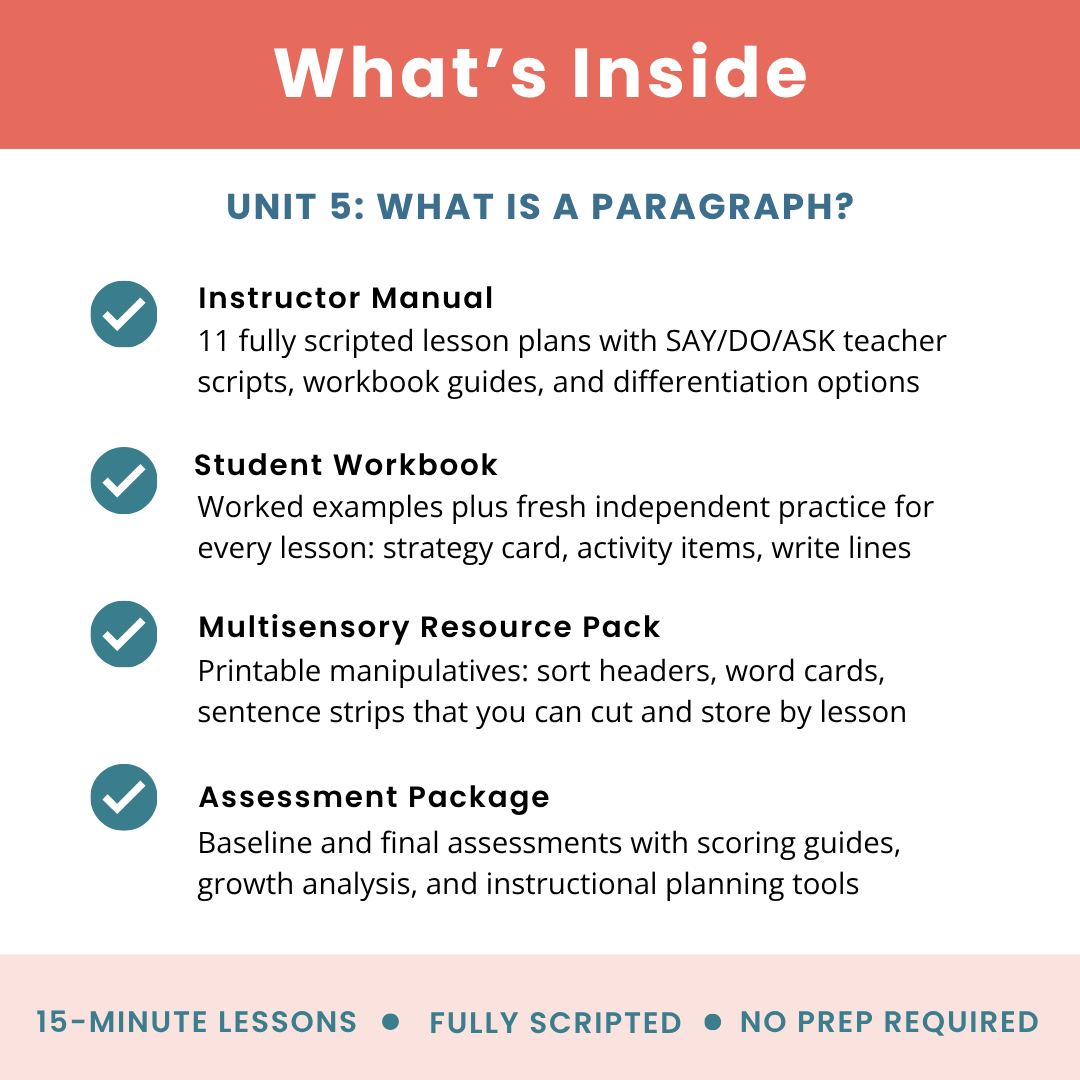
11 fully scripted lesson plans with SAY/DO/ASK teacher scripts, workbook guides, and differentiation options.
Worked examples plus fresh independent practice for every lesson: strategy card, activity items, and write lines.
Printable manipulatives: sort headers, word cards, and sentence strips you can cut once and store by lesson.
Baseline and final assessments with scoring guides, growth analysis, and instructional planning tools.
Every lesson gives students a worked example first, then fresh practice of their own. The STEMS strategy card sits on the page, so students are never guessing at what a sentence is supposed to do.
Pages are print-ready and sit directly alongside the instructor manual, lesson by lesson.
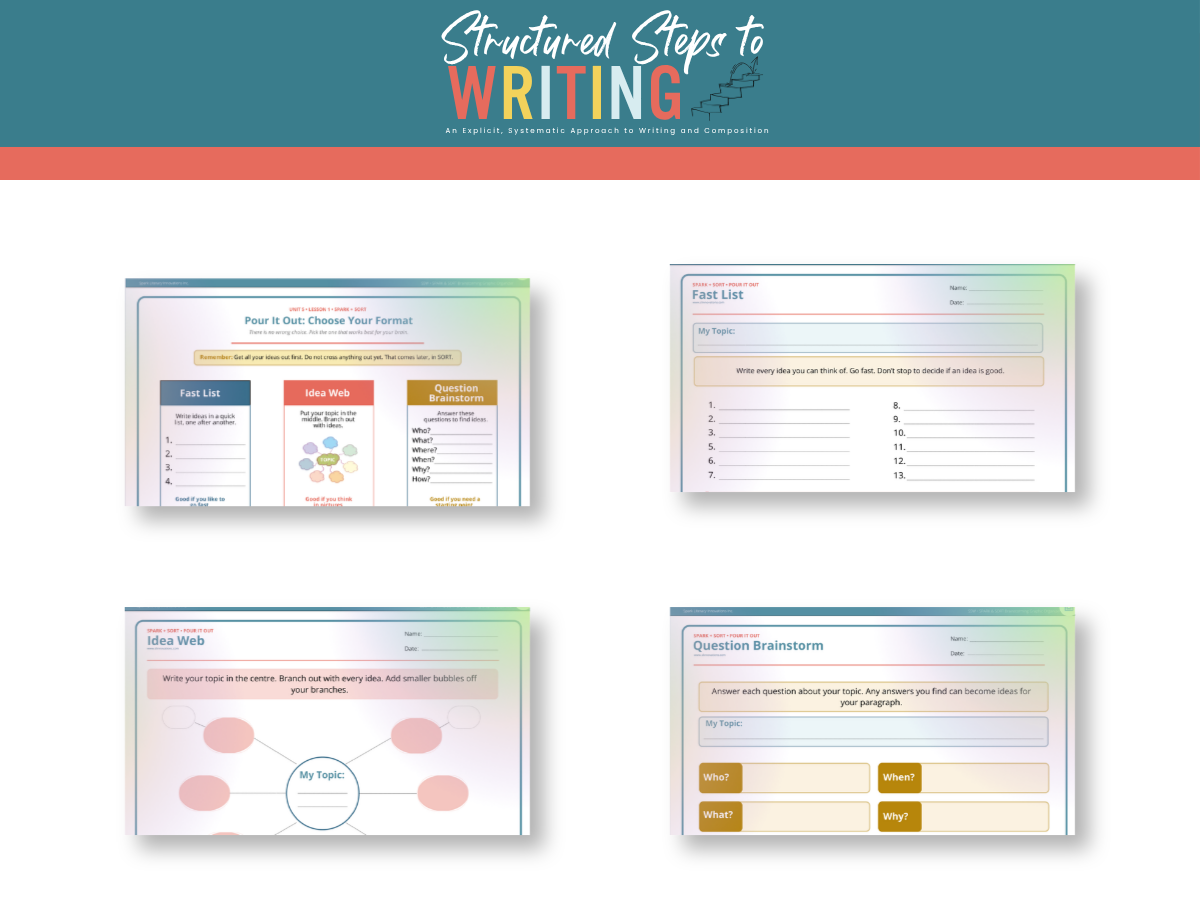
Pour It Out is the stage where students get every idea onto the page before they judge any of it. Some students need a list. Some need to see ideas branch. Some need a question to push against.
So they get three formats and a chooser page to pick between them: Fast List, Idea Web, and Question Brainstorm. Same stage, three ways in, so a student who freezes on one has somewhere else to go.
Yours at no extra cost with Unit 5.
Ask a student to "check their work" and most will reread it once, change a word, and hand it back. They were never shown what they're checking for.
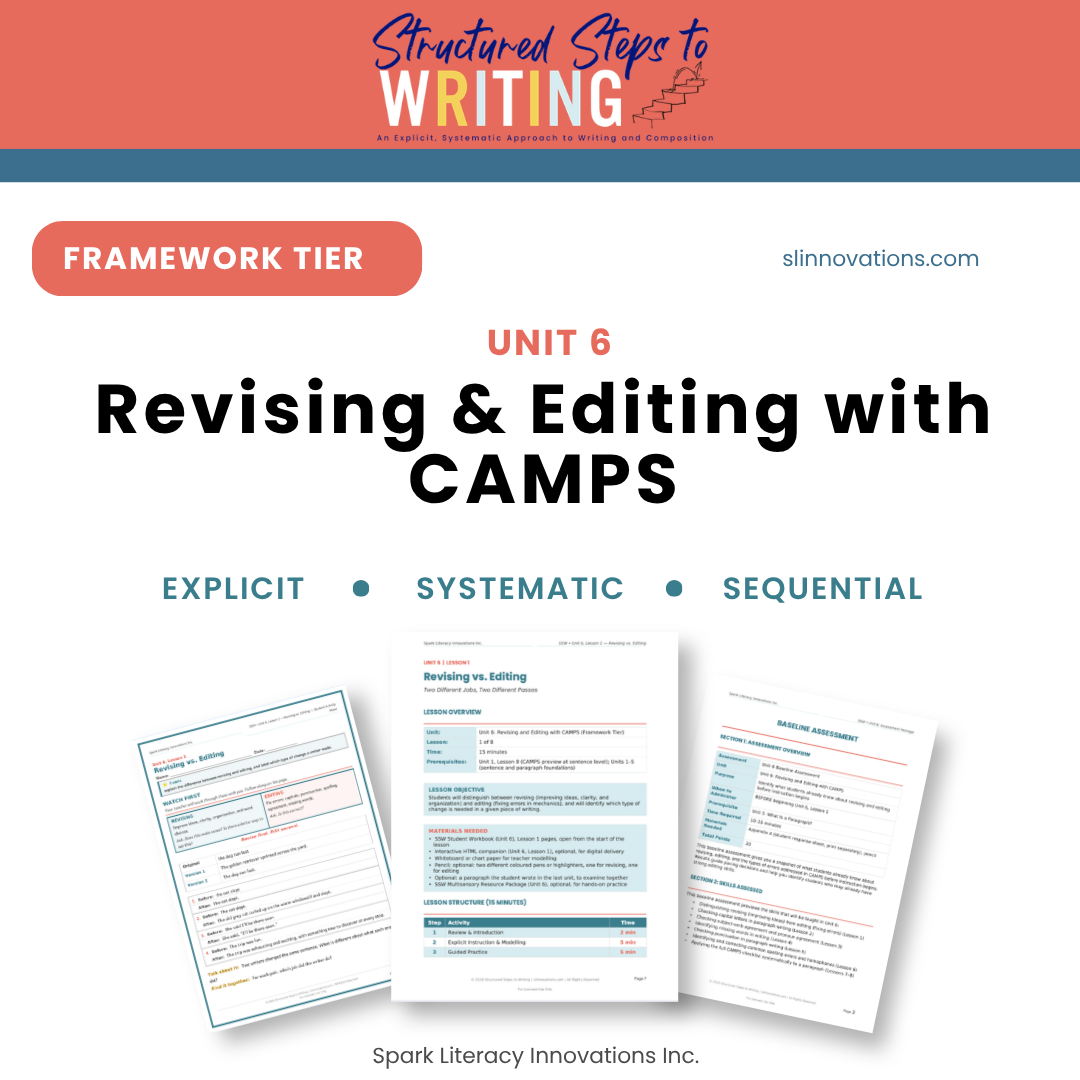
So Unit 6 names the two jobs first. Revising makes the ideas stronger. Editing fixes the errors. Then it teaches editing one letter of CAMPS at a time, in the student's own STEMS paragraphs.
By the last lesson, students plan with SPARK+SORT, draft with STEMS, and run the full CAMPS checklist on their own writing.
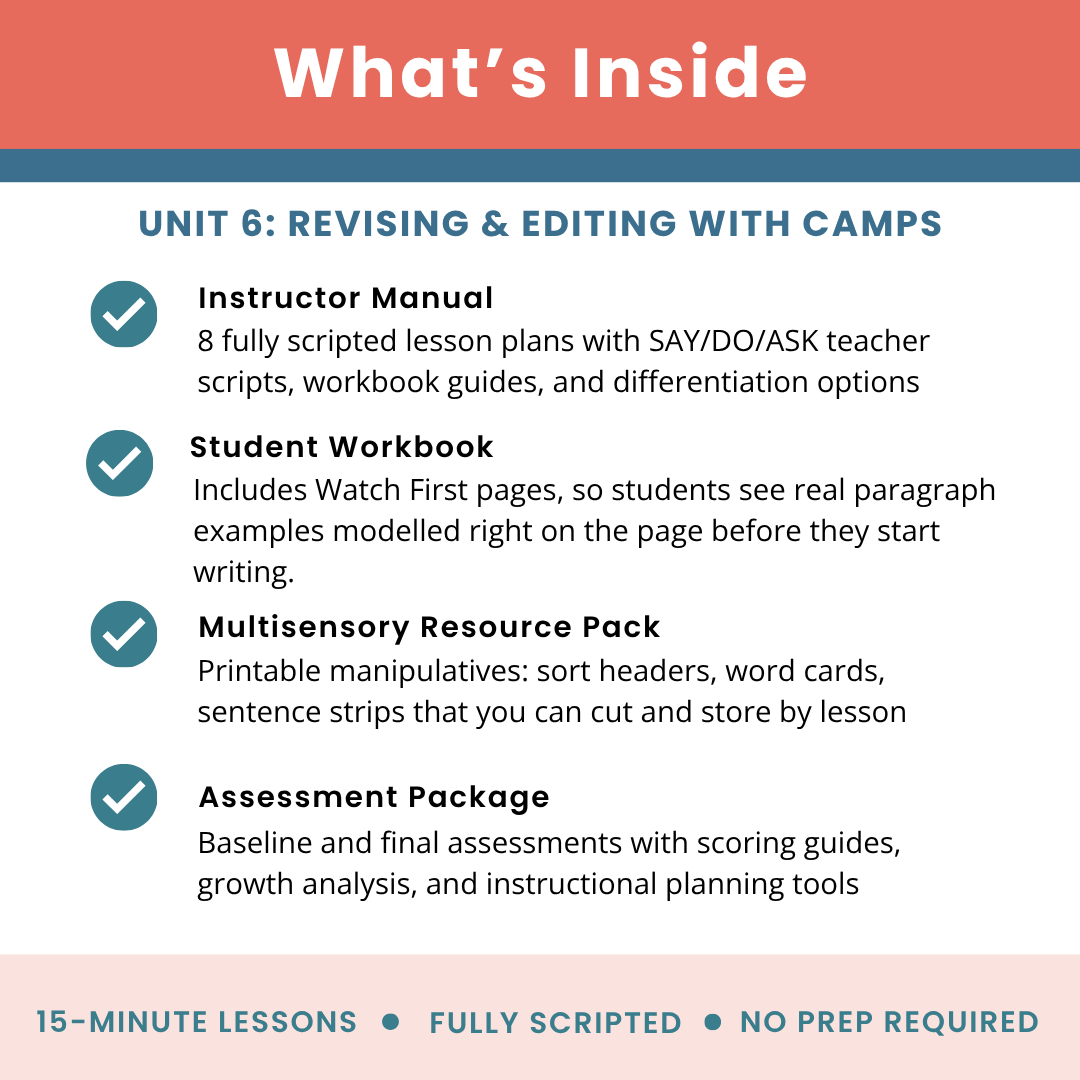
8 fully scripted lesson plans with SAY/DO/ASK teacher scripts, workbook guides, and differentiation options.
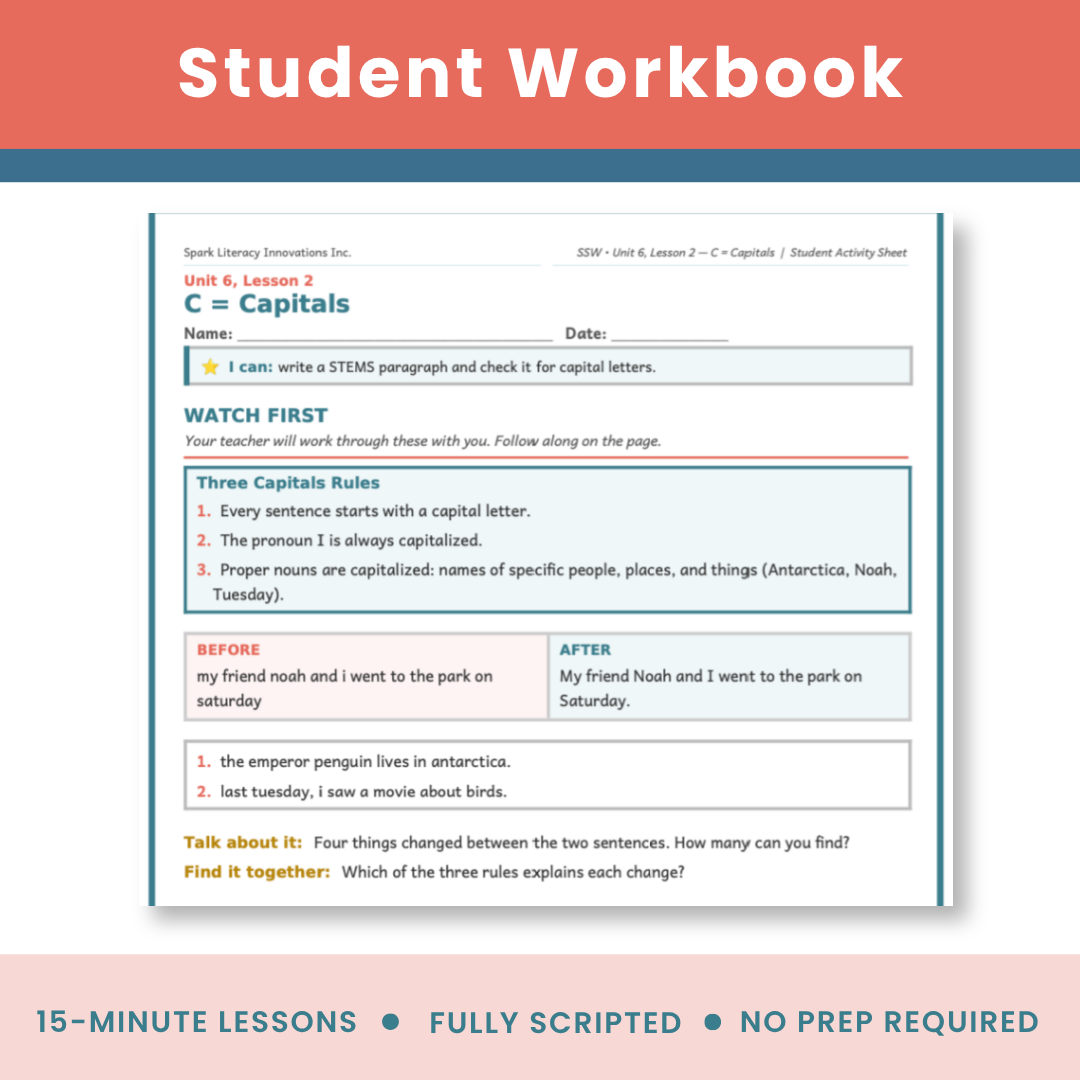
Watch First pages in every lesson, so students see a real paragraph modeled on the page before they start writing.
Printable manipulatives: sort headers, word cards, and sentence strips you can cut once and store by lesson.
Baseline and final assessments with scoring guides, growth analysis, and instructional planning tools.
Each lesson opens with a Watch First block. You work through a before-and-after example together, so students see exactly what changed and why, before they check a paragraph of their own.
Then they write a STEMS paragraph and check it for that lesson's CAMPS letter. One letter at a time, until they can run all five.
By the end of Unit 6, a student can build a STEMS paragraph and check it with CAMPS. Units 7 and 8 sharpen the grammar and punctuation inside that paragraph, one tool at a time, each tied to the CAMPS letter where students will check for it.
Then Unit 9 zooms out. Students learn what each paragraph in an essay is for, and plan one before they write it.
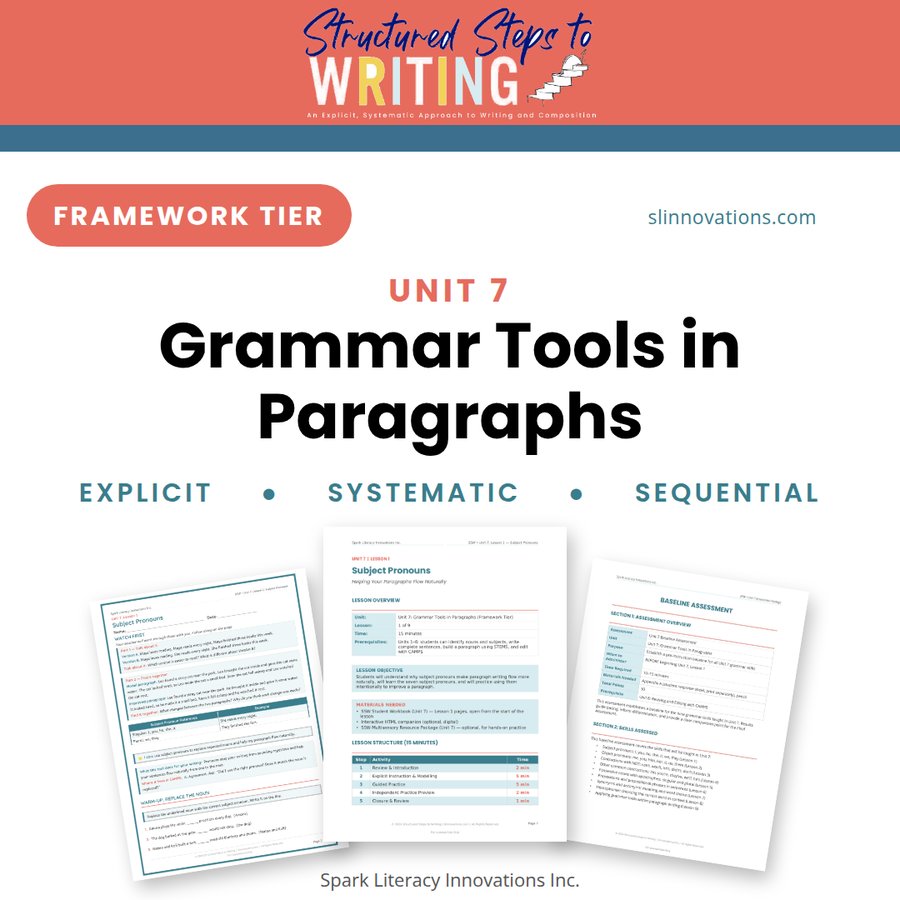
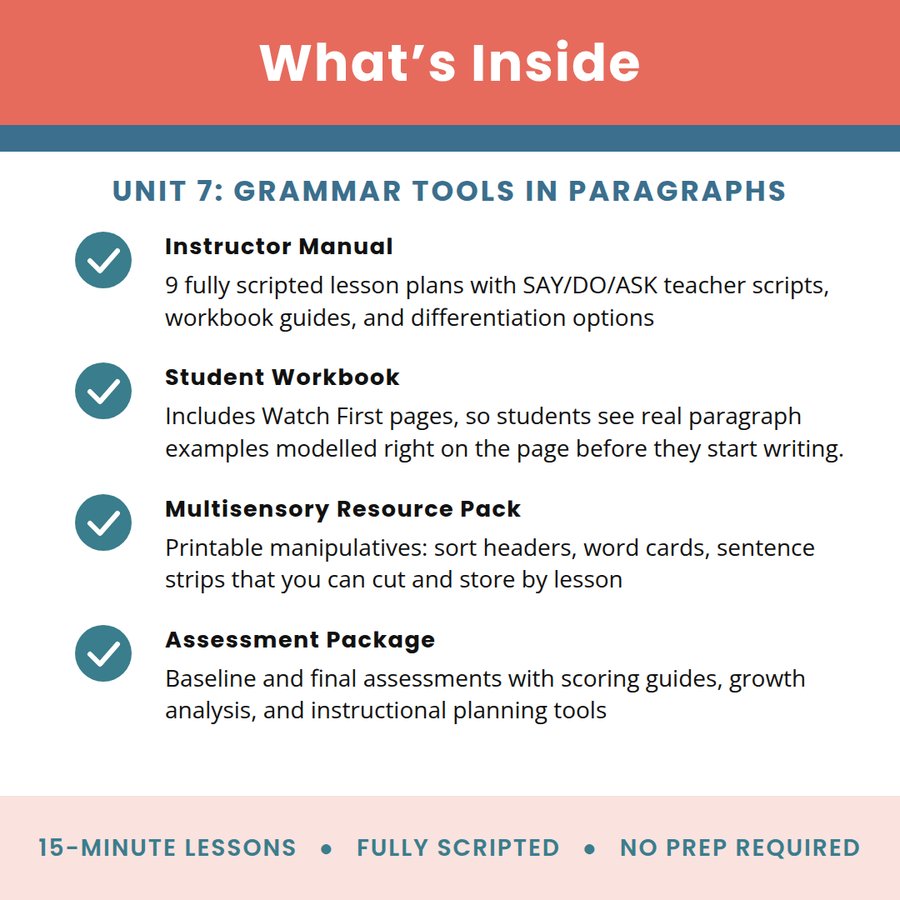
Eight grammar tools, each tied to the CAMPS letter where students will check for it. Pronouns live in A for agreement. Contractions, possessives, synonyms, and homophones live in S. Prepositions live in P.
Every lesson opens with two versions of the same short paragraph. Your student hears the difference and names it before the grammar term ever comes up. Then they practice the tool, use it in a paragraph of their own, and fix one that needs it.
The unit ends with a full STEMS paragraph on a topic your student chooses, revised and edited with every tool. Builds on the CAMPS editing from Unit 6.
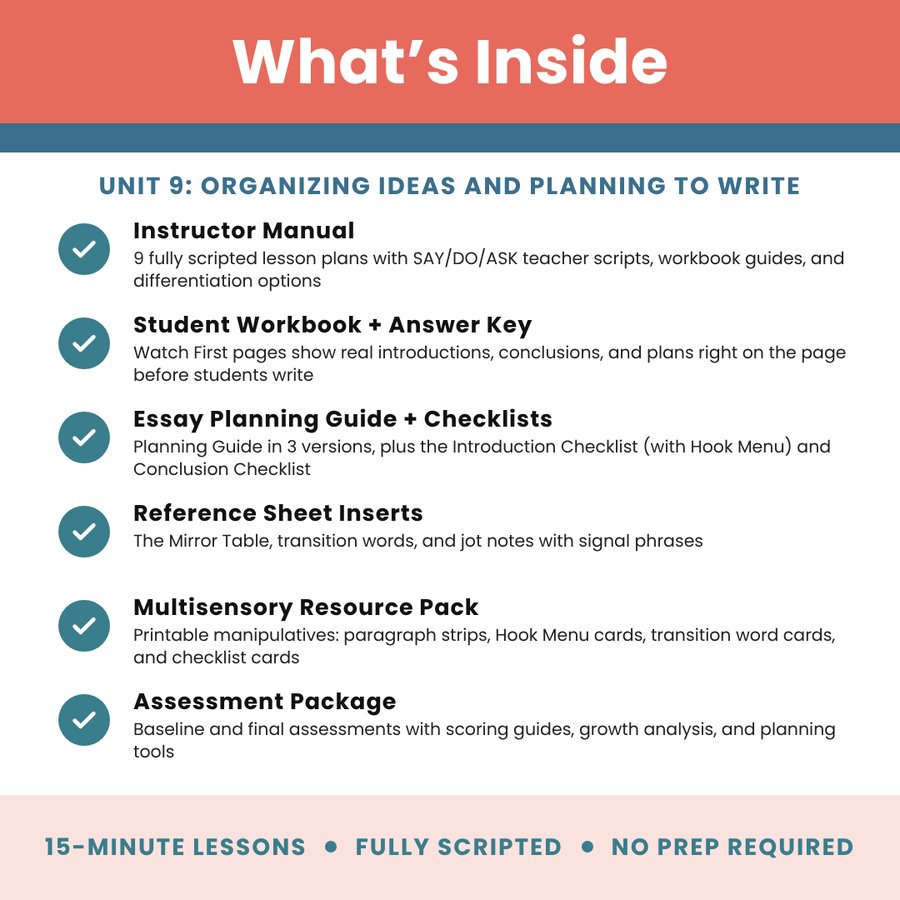
9 fully scripted 15-minute lessons with SAY, DO, and ASK for every step, plus differentiation options.
Worked examples, writing tasks, sentence starters, and five reference charts students keep on the desk.
Sort cards, matching pairs, and fix-it strips you can cut once and store by lesson.
Baseline and final assessments with scoring guides and growth analysis.
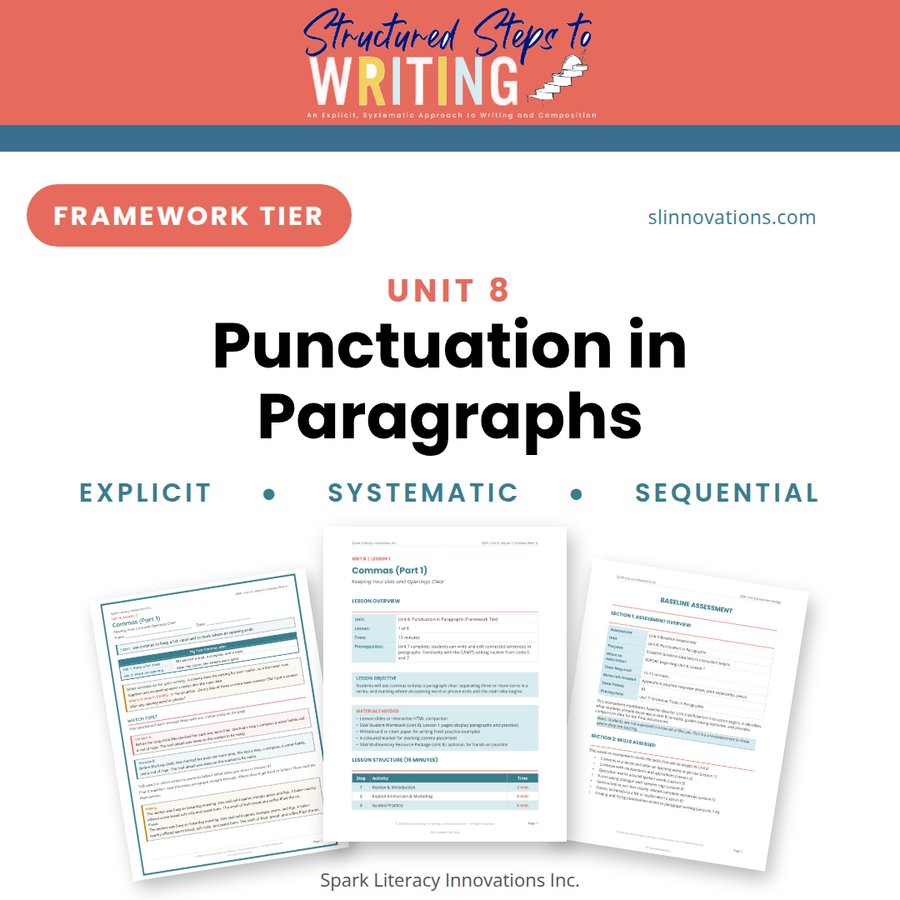
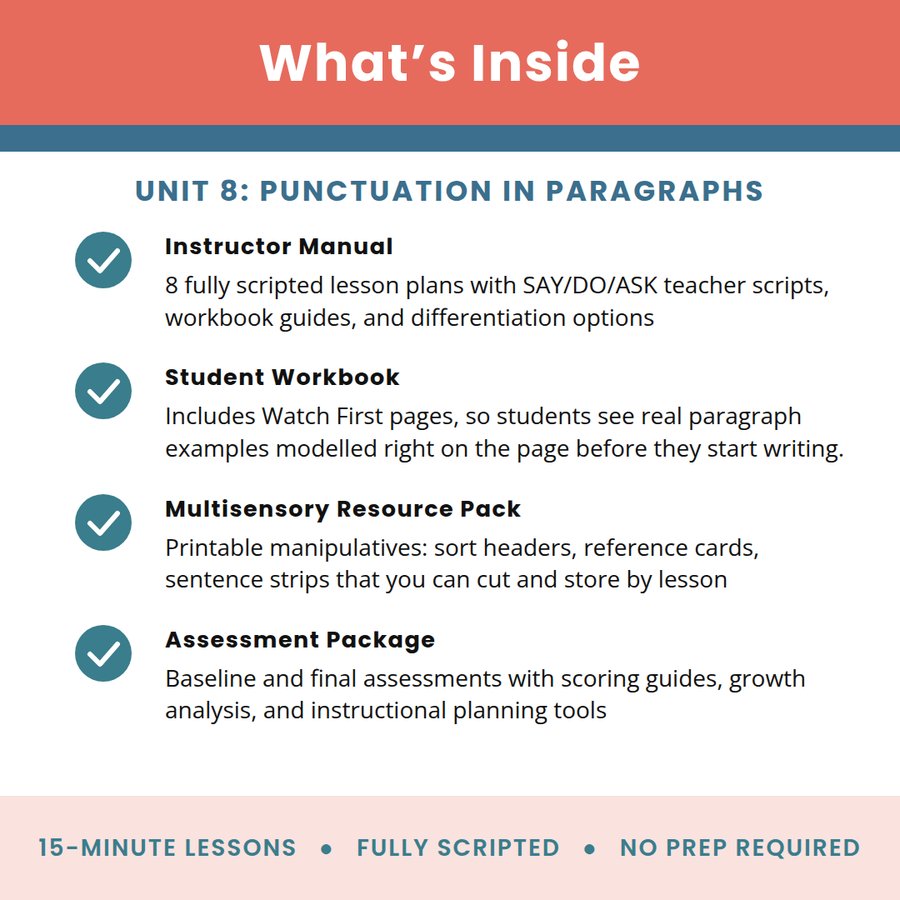
The punctuation that holds a paragraph together: commas for four different jobs, quotation marks for dialogue, semicolons, and colons. Every mark connects to the P step of CAMPS.
Each mark opens with two versions of a short paragraph, so your student spots what the punctuation is doing before the rule is named. Then they practice it, write with it, and fix a paragraph that gets it wrong.
The unit ends with a routine your student keeps for good: checking a paragraph one punctuation mark at a time, first on a practice paragraph and then on their own writing. Builds on Units 6 and 7.
8 fully scripted 15-minute lessons with SAY, DO, and ASK for every step, plus differentiation options.
Practice for every mark, reference cards, a Star Challenge for students ready to stretch, and an answer key.
Printable punctuation cards and sentence strips for hands-on sorting and building.
Baseline and final assessments with scoring guides and growth analysis.
From a single paragraph to a fully planned essay. Students start by taking apart a model essay to see how it is built, then learn to plan their own with the Essay Planning Guide.
Body paragraphs are planned with STEMS, the tool they already know. Introductions and conclusions get their own lessons, with a Hook Menu and checklists so your student always knows what each one needs.
By the end, your student plans a new essay on their own and drafts its introduction and conclusion, ready for the full essays in Composition. Builds on Units 5 to 8.
9 fully scripted lessons of 15 to 20 minutes, with SAY, DO, and ASK for every step, plus differentiation options.
Practice for every lesson with an answer key, plus three reference sheets students keep.
Paragraph strips and cards, and the Essay Planning Guide in three levels of support.
Baseline and final assessments with scoring guides and growth analysis.
Unit 5 assumes a student can already write a complete sentence and has met SPARK+SORT in Unit 4. The unit opens with a baseline assessment that checks exactly that, so you'll know within the first lesson. Each unit builds on the one before, so most students take them in order.
The Writing Skills Placement Screener takes about 20 minutes to administer and tells you which unit to start in. If sentence skills aren't solid yet, it will say so.
Still building sentences? Start with the Foundations units.
Framework runs from Unit 5 to Unit 9 and takes a student from a single paragraph to a planned essay. All 5 units are available now. Composition (Units 10 to 12) comes next.
See all twelve units, lesson by lesson
Want to hear when Composition is ready? Join the list.
Build the paragraph, make it better, then plan the essay. 15 minutes a lesson. Everything scripted.
Questions first? Get in touch.